BAVARIA CRUISER 34
- LOA
- 35.14 ft
- Builder
- Bavaria
- First Built
- 2000
Mainsails from $1,049.77
Sailmaking
Every mainsail we build is designed and made in our own sail loft in Phuket, then shipped worldwide to your marina or home. Find your boat among 12,463+ models for instant pricing, or send your rig measurements for a custom quote. Cruising mainsails from around $800.
Search our sailboat database to find supported boat models, view available sails, and access instant online pricing.
Browse all sailboatsLooking for a specific builder or model? Start typing to search the archive, or browse the full sailboat database.
Mainsails from $1,049.77
Mainsails from $1,742.98
Mainsails from $1,008.85
Mainsails from $1,047.87
Choosing a new mainsail changes how your boat sails more than almost any other single upgrade. It is the primary engine of the boat, and the right shape, cloth and construction make a measurable difference to drive, handling and confidence on the water.
The right mainsail depends on your rig, your furling or reefing system, crew size and where you sail. Full batten, short batten, in-mast furling, square top and high-roach mains can all be priced online on your boat's page; in-boom furling mains are quoted from your furler's specifications. We advise on what suits each mast, boom and sail plan.
A full batten mainsail has battens running the full width of the sail, from luff to leech. They hold a clean, efficient profile under load, reduce flogging in gusty conditions and flake neatly when reefed. They suit bluewater cruisers, catamarans and any yacht where stable sail shape and quiet handling matter. The trade-off is extra weight at the leech and the need for a robust batten car system and a compatible mast track. We build full batten mainsails in cross-cut Dacron or radial layouts, depending on sail area and performance goals.
The conventional, slab-reefed mainsail fitted to most production cruisers (Catalina, Beneteau, Jeanneau and similar), with short battens in the leech and slides or cars on the mast track. It is the simplest, most cost-effective option and the easiest to repair, and it suits short-handed coastal sailing, charter fleets and budget-conscious replacements. One reef point comes as standard, and you can add more when you price it. We discuss reef positions and line leads when we confirm your order.
An in-mast furling mainsail (listed as "Furling Mainsail" when you price your boat) rolls around a mandrel inside the mast, so you can reef or stow it entirely from the cockpit. The system needs a flatter, low-stretch sail with a hollow leech and no roach, which means less sail area than a conventional main, and a poorly cut sail can jam when furling or unfurling. We choose a dimensionally stable woven polyester or cruising laminate, reinforce the luff and tune the leech profile to reduce jamming and keep the sail driving well when fully out.
An in-boom furling mainsail rolls into the boom while the luff stays on the mast track. Unlike in-mast systems, it keeps full battens, more sail area and moderate roach, so you get something close to a conventional main's power with the convenience of furling. The sail must be cut and reinforced specifically for even rolling, with a controlled batten layout and correct foot tension, so in-boom mains are built to quote rather than priced online. Send us your furler make and model with your measured P and E, and we design a main that furls reliably and still pulls the boat well.
Square-top and high-roach mainsails add area at the head of the sail, where the wind is cleaner. Both can be priced online as separate types. Originally a racing development, they now appear on performance cruisers and catamarans looking for extra power aloft. The key design points are top batten support, backstay clearance (or a no-backstay rig) and careful leech tension. Moderate roach adds drive without overloading the mainsheet or vang, and if your original main is under-canvassed, a higher-roach profile can transform light-air performance.
Every mainsail comes with a leech and foot line and leech tell-tales, and non-furling mains include one reef point. When you price your boat you can add extra reef points, a Cunningham, an offshore reinforcement package, full batten pockets, heavy-duty batten receptacles, a clew block, black Dacron, and a Sauleda or Solartex sail cover. We can also build the foot loose (attached at tack and clew only, for easier outhaul control and a cleaner foot shape) or match your existing bolt-rope or slide foot.
Panel layout
Cloth choice and panel layout have more impact on a new mainsail than most hardware upgrades. A heavy-displacement cruiser needs a sturdier sail than a light racer, and the conditions you sail in affect the right fabric. Getting this right decides how well the sail holds its shape over thousands of miles.
Cross-cut vs radial layouts: Cross-cut mainsails use horizontal panels of woven polyester, making efficient use of cloth and keeping cost down. This is the default for coastal and bluewater cruising, where durability matters most. Radial mainsails (tri-radial or bi-radial) align the cloth with the load paths from head, tack and clew, so they handle higher loads and hold their shape longer, which suits larger boats and owners chasing performance.
Cross-cut
Radial
Sailcloth
Cruising mainsail cloth: For most cruising boats we specify woven Dacron from Challenge Sailcloth or IYU, in cross-cut or radial layouts, with Dimension-Polyant laminate when you want more shape holding. Dacron is durable, UV-resistant, forgiving and repairable, though it stretches over time; choosing the right weight and finish for your boat's displacement and sail area manages that stretch and extends its life. For bluewater passages we move to heavier cloths with stronger UV coatings, balancing weight against longevity.
Performance and club-racing cloth: Owners who want a faster, flatter mainsail benefit from higher-modulus woven polyesters or cruising laminates, usually in a radial layout. Laminates with aramid or carbon hold their shape well but degrade faster in UV, so we match the material to how the boat is actually used, including short-handed sailing and storage on the boom. Read more in our sailcloth guide.
Details that extend sail life: Every new mainsail we build has reinforced corners at head, tack and clew, reinforced reef points, a leech and foot line to control flutter, leech tell-tales, batten pockets to suit the sail type, and hardware sized for your boat. These details separate a sail that keeps its shape season after season from one that bags out early.
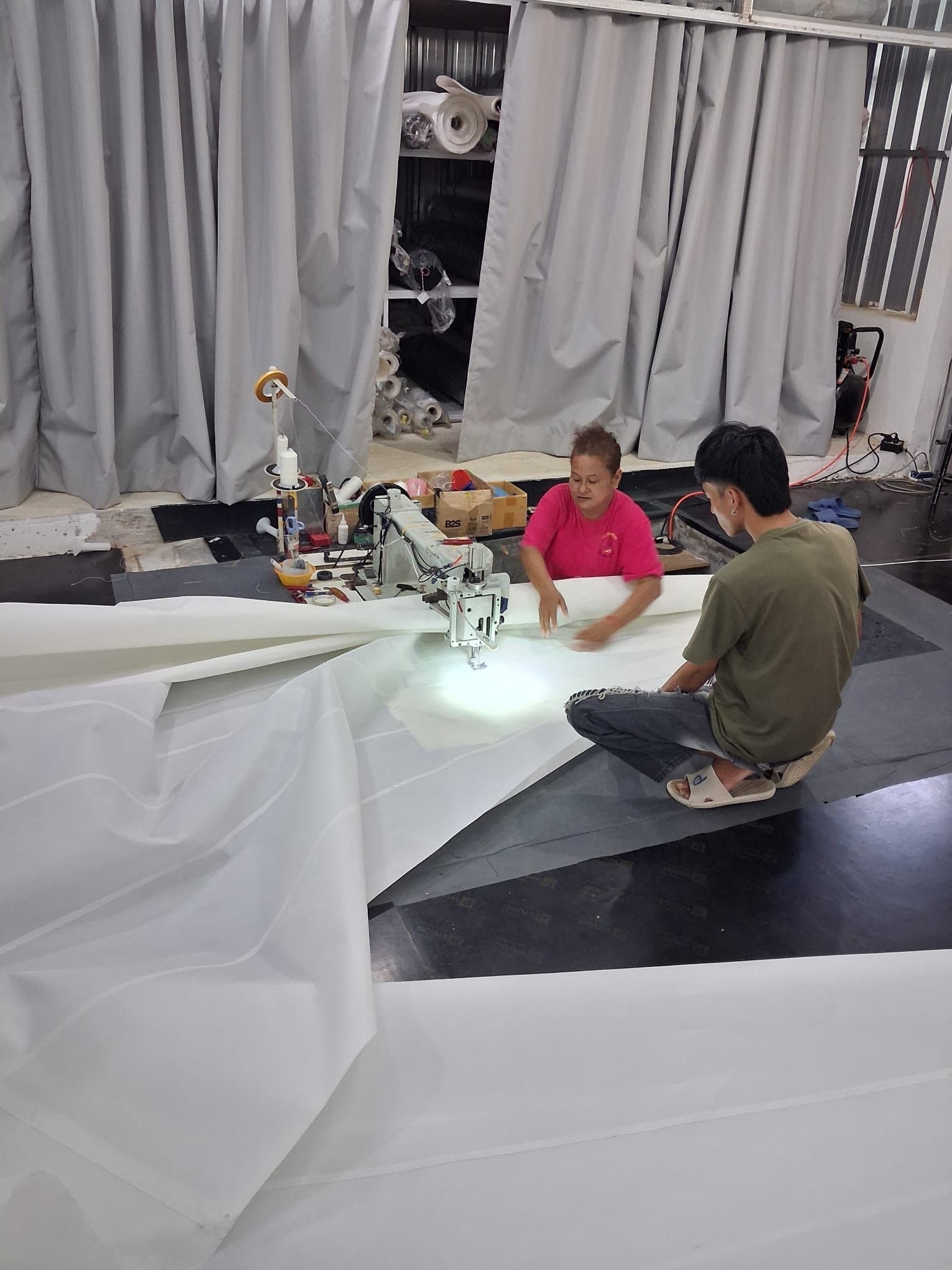
Every new mainsail is designed with ProSail software, cut on digital plotters and finished by hand in our Phuket sail loft. Each sail is a one-off, shaped around your boat, your rig and how you actually sail.
We use sailcloth from Dimension-Polyant, Challenge Sailcloth and IYU, with reinforcements, batten pockets and hardware specified for your boat's displacement and real cruising loads.
Most owners find their boat in seconds and see instant pricing. Non-standard rig or boat not listed? Our measuring guide and direct support from the loft get you to a precise quote quickly.
Every sail carries a one-year warranty on materials and workmanship, and our 4.7-star Google rating reflects the build quality, communication and after-sales support sailors get. Read the reviews before you order.
FAQ
Price depends on boat size, cloth, panel layout and options such as extra reef points or offshore reinforcement. A cruising mainsail for a typical 30-foot yacht starts from around $800, while a radial laminate for a 50-footer costs considerably more. Search our database of 12,000+ boats for instant pricing on your model, or ask for a tailored quote if your rig is non-standard.
In-mast furling offers very simple handling and infinite reefing from the cockpit, but gives up roach and sail area. In-boom furling keeps more area and full battens, but adds complexity at the boom. We design each mainsail specifically for its furling system and can advise based on your crew size, sailing plans and existing hardware.
For older or short-handed crews who prioritise safety and easy reefing, in-mast furling can be a genuine advantage: you reef or stow without leaving the cockpit. The trade-off is less sail area and reliance on a well-maintained furler. A correctly cut, low-stretch mainsail is the key to avoiding jams and keeping acceptable drive, and we tailor the cloth and profile to your set-up.
For most production boats we already hold the rig data. If dimensions need checking, follow our measuring guide for P, E, luff, leech and foot lengths using a tape and halyard, and double-check them against your existing sail and your mast and boom fittings. Photos of the hardware help us confirm the design, and we review every measurement before finalising it.
A well-built cruising Dacron mainsail typically gives 5–10 years of regular use, depending on how hard it works and how much sun it sees. Performance laminates trade some longevity for better shape. UV, flogging, overloading and storage matter as much as age. A baggy draft, broken stitching or a leech that won't hold tension are signs it is time for a new sail.
Typical lead time is 4–6 weeks from confirmed order to dispatch. That covers design, cutting, assembly and finishing in our Phuket loft. We confirm current timing when we quote, so you can plan around haul-outs or cruising departures.
Yes. We ship new mainsails worldwide from Phuket, including to Europe, North America, Australia and around Asia. Sails are rolled, bagged and packed for transport, with tracked shipping and the shipping documents provided. Share your marina or yacht-club delivery details when ordering to make customs and handover simpler.
Your boat's make, model and year; the rig type (slab-reefed, in-mast or in-boom furling); how you sail (coastal, offshore or racing); and the rough age and condition of your current main. If your boat is not in our database, accurate rig and boom measurements plus a few photos of the existing sail and hardware let us design and quote it precisely.
Our Process
From first enquiry to a finished mainsail on your boom, the process is straightforward, whether you are in Phuket or on the other side of the world.
Step 1
Most owners start by searching our database of 12,000+ sailboats for instant mainsail pricing from stored rig dimensions. A Catalina 30, for example, shows its P, E and mainsail price straight away. If your boat or rig is non-standard, follow our measuring guide and send your P, E, luff, leech and foot lengths for a custom quote.
Step 2
We review your rig, talk through mainsail type, cloth, reefing and extras, then send a clear written quote. Once you approve the details (sail numbers, logos, reef positions, cloth and layout), your sail enters the build queue.
Step 3
Your mainsail is designed in ProSail, digitally plotted and cut, then assembled and finished on the loft floor. We check stitching, reinforcements and final measurements before packing. Typical lead time is 4–6 weeks from order confirmation, depending on season and specification.
Step 4
Finished sails are rolled, bagged and shipped with tracking to marinas and private addresses worldwide. We provide the shipping documents and answer fitting and rigging questions by email or phone once the sail arrives.
A mainsail built for your rig gives better drive, easier reefing and quieter, more controlled handling. Find your boat for instant pricing, or send us your measurements for a custom quote. Every sail is backed by our one-year warranty on materials and workmanship.
We want to hear from you
Can’t find your sailboat in our database or have some specific requirements for your project? We are here to help customise our products to your needs. Please give us all the details we need in the form and we will be in contact within 24 hours.